
A framework to support designers in enhancing End-of-Life literacy
Western societies often treat death as a taboo subject, which can hinder access to care and increase emotional burden and distress. Improving our approach to death is a challenge that designers are motivated to tackle.
To help with this, I created a framework to help designers create interventions that increase people’s end-of-life literacy. The result is a foundational resource that can help navigate designing for death and for improving the quality of our final stage of life.
Context
This individual research project was done as part of the Design for Interaction master programme, in partnership with the Delft Design for End of Life Lab.
Supervisor
- Marieke Sonneveld (TU Delft)
Approach & Methods
- Literature research (on death literacy, grief, health education)
- Expert interviews
- Focus group discussions
- Online facilitation (with undergraduate & postgraduate design students)
Tools
- Miro (to map framework development and feedback)
- Zoom (for remote workshops and interviews)
- Adobe Illustrator (visualising the framework)
- Adobe Premiere Pro (video production for evaluation)
The process
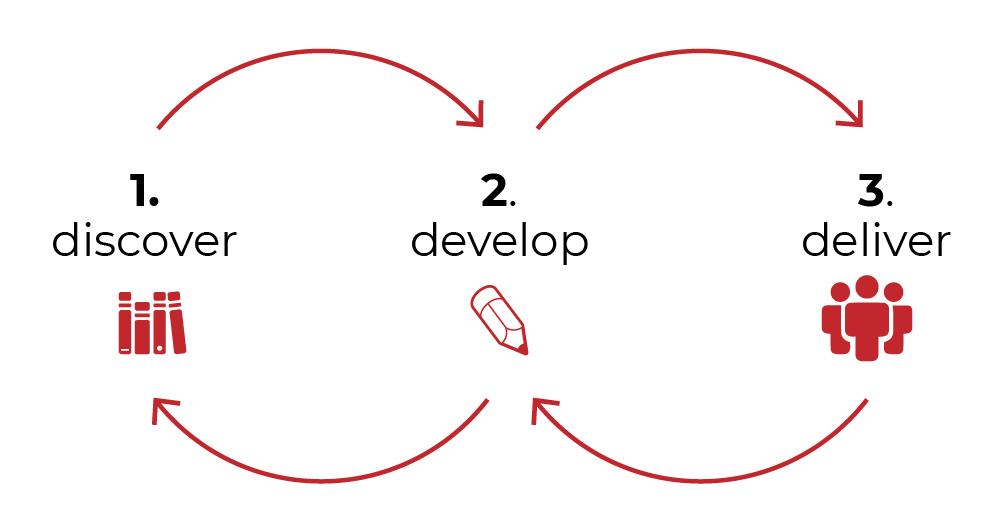
How can design contribute to greater awareness, competence, and agency around death and dying? The research was done in three stages: Discover, develop, deliver.
First, I read research papers on death education, grief, health literacy, experiential learning, and behaviour change.
I then worked with people from the End of Life Lab to come up with the main ideas and create the framework. To test how useful it was, I ran a 3-day (online) design workshop for undergraduate students at HfG Schwäbisch Gmünd, followed by three other sessions where I asked postgraduate students at TU Delft for their feedback.
These co-creative environments provided essential feedback to improve the framework and show areas that needed more development. They showed how important it is to have clearer definitions and formulations, as some terms were abstract or ambiguous. While this ambiguity could be thought-provoking and help with creativity, it could also make it hard to use the framework.
Results
The framework consists of multiple visuals depicting relevant concepts for designers working on end-of-life topics.
The main practical result is an “Engagement-skills matrix” which categorises relevant activities, knowledge and skills. These categories can provide ideas on how to enhance knowledge of end-of-life matters, for example through media consumption or community engagement, and highlight various beneficial skills, such as being able to talk comfortably about death or possessing the hands-on skills required to care for a dying person. Designers can use this grid to organise their ideas and define the scope of what is often an amorphous challenge, providing it with structure.
Benefits
This project laid essential groundwork for a complex but under-explored area within design, including:
- A deeper understanding of how end-of-life literacy is formed, and how design can support that process across individuals and communities
- A practical framework that can evolve into a toolkit for designers working with sensitive, end-of-life topics
Future iterations should feature stronger visual examples and involve designers from the outset, refining and validating the framework in collaboration with professional designers and healthcare stakeholders.